Updated September 2026
Amazon affiliate disclosure: KitchenFitly is a participant in the Amazon Services LLC Associates Program. As an Amazon Associate, we earn from qualifying purchases. This does not affect our recommendations.
Method: This guide separates rated wattage, actual energy consumption, heat settings, and circuit load. Product labels and manuals are the controlling sources for a specific cooktop. We do not rely on copied Amazon specifications, ratings, reviews, prices, or images.
Most full-power portable induction cooktops sold for standard U.S. outlets are rated around 1,500 to 1,800 watts. Compact or power-limited models may offer settings near 600–1,300 watts, while double-burner units often share a maximum input across both zones. The wattage printed on the nameplate is the maximum electrical demand—not the amount consumed continuously during every cooking session.
At 1,800 watts on a nominal 120-volt supply, the approximate current is 15 amps before allowing for real-world variation. That is why outlet condition, circuit capacity, other appliances, and the manufacturer’s instructions matter. A high setting can approach the practical limit of a typical household branch circuit.
Quick answer by use case
| Cooking task | Typical useful power range | What to expect |
|---|---|---|
| Keeping warm or very gentle simmer | Low setting; displayed wattage may cycle | Cooktop may pulse power rather than deliver a perfectly continuous low heat |
| Eggs, oatmeal, sauce | 600–1,000W | More control and lower circuit demand |
| Everyday sautéing and boiling | 1,200–1,500W | Strong balance of speed and electrical headroom |
| Fast boiling or searing | 1,600–1,800W | Highest circuit load and more need for compatible cookware |
| Two-burner cooking | Check total shared maximum | Both zones may not run at their individual maximum simultaneously |
These are practical ranges, not universal performance guarantees. Manufacturers implement power levels differently, and actual heating depends on pan size, magnetic properties, food quantity, and temperature.
Watts, watt-hours, and kilowatt-hours
Watts describe the rate at which an appliance uses electrical power. Watt-hours and kilowatt-hours (kWh) describe energy used over time—the unit commonly shown on an electricity bill.
Use this basic estimate:
Energy in kWh = watts ÷ 1,000 × hours used
If a cooktop drew a constant 1,800 watts for 30 minutes, the theoretical maximum would be:
1,800 ÷ 1,000 × 0.5 = 0.9 kWh
But induction controls often cycle after the pan reaches temperature, so measured energy may be lower. To estimate cost:
Cost = kWh used × your electricity rate per kWh
For example, at an illustrative rate of $0.18 per kWh, 0.9 kWh would cost about $0.16. Use your actual utility rate; taxes, tiered rates, and time-of-use pricing can change the result.
Does an 1,800W cooktop always use 1,800 watts?
No. The rating is usually the maximum input. Lower power settings reduce the average draw by changing the inverter output or cycling power. Once water boils or a pan reaches the set temperature, the unit may alternate between heating and pausing.
This is why multiplying maximum wattage by the entire time can overestimate normal energy use. A plug-in energy meter can measure real consumption for a specific meal, but it must be rated for the cooktop’s voltage and current. Never use an undersized meter, adapter, or extension cord.
1,300W vs 1,800W: which should you choose?
Choose about 1,300W when:
- Your main tasks are simmering, eggs, oatmeal, soup, and one-person meals.
- You have limited electrical capacity and the appliance instructions permit the intended circuit.
- You value a slightly lower maximum load more than the fastest boiling.
- You use smaller compatible cookware.
Choose up to 1,800W when:
- You regularly boil larger pots of water.
- You sauté, sear, or cook at high power.
- The outlet and circuit are suitable and do not share heavy loads.
- You want the broadest power range and can manually choose lower levels.
An 1,800W cooktop is not forced to run at maximum. A model with well-spaced low settings can be more versatile than a lower-rated model with coarse control.
Can a portable induction cooktop use a normal outlet?
Many U.S. portable models are designed for a standard 120V receptacle, but “fits the outlet” is not enough. Read the nameplate and manual. At 1,800W and 120V, the simplified calculation is:
Current = watts ÷ volts = 1,800 ÷ 120 = 15 amps
Do not run another high-wattage appliance—such as a microwave, toaster oven, kettle, space heater, or second cooktop—on the same circuit unless the electrical system and instructions support the combined load. Breaker trips are a warning to stop and investigate, not an inconvenience to defeat.
Old, loose, discolored, cracked, or unusually warm outlets should be evaluated by a qualified electrician. Never alter a plug or use an adapter to bypass grounding.
Extension cords and power strips
The safest approach is to plug the cooktop directly into an appropriate wall receptacle when the manual requires it. High-wattage cooking appliances can overload light-duty extension cords or power strips. The U.S. Consumer Product Safety Commission warns against overloading cords and advises matching a cord’s wattage rating to the appliance.
- Do not use a power strip simply to create more high-power outlets.
- Never run a cord under a rug, carpet, or mat where heat cannot escape.
- Keep cords away from water, hot cookware, and counter edges.
- Stop using any cord or plug that becomes hot, cracked, loose, or discolored.
- If the cooktop manual prohibits extension cords, do not use one.
Single vs double burner wattage
A double-burner cooktop can display high settings for both zones while limiting the total input. For example, when one zone receives more power, the other may be capped automatically. Do not add the two displayed burner ratings and assume both are delivered simultaneously.
Check the manufacturer’s table for combined-power rules. If you need two pans at full output, a portable double unit on one standard circuit may not behave like two independent full-power burners. Our single- vs double-burner induction cooktop guide explains the space, power-sharing, and cooking tradeoffs.
Why cookware changes performance
Induction creates an electromagnetic field that transfers energy into compatible cookware. The U.S. Department of Energy explains that a flat-bottom pan a magnet sticks to will generally work. A poorly matched, warped, very small, or off-center pan may heat less effectively or fail detection.
Better coupling can shorten cooking time, reducing total energy even when maximum wattage is unchanged. Match the pan-base diameter to the manufacturer’s supported zone and keep the glass surface and pan bottom clean.
Induction efficiency does not mean zero heat loss
DOE notes that induction transfers energy directly to cookware and is more efficient than gas and somewhat more efficient than conventional smooth-top electric cooking. The glass still becomes hot from contact with the heated pan, and food, steam, and cookware all lose heat to the room.
Use a lid when appropriate, match pot size to the meal, and avoid maintaining a rolling boil when a simmer is enough. Those habits can reduce both time and energy.
Best wattage for a dorm room
A dorm’s appliance policy matters more than its outlet shape. Some residences prohibit exposed cooking appliances entirely; others restrict wattage, require automatic shutoff, or allow cooking only in a shared kitchen.
Get written policy confirmation before buying. Our dorm-friendly induction cooktop guide focuses on permission, storage, controls, and safety rather than assuming every dorm allows a burner.
Best wattage for a small apartment
For one-person meals, 1,200–1,500W is often enough for routine cooking, while an 1,800W ceiling provides faster high-heat performance. More important features include low-power control, pan detection, temperature settings, timer behavior, ventilation clearance, and a size that leaves safe prep space.
See our best induction cooktops for a small apartment for product-selection criteria.
our guide to the best compact induction cooktops
How to estimate monthly electricity use
- Find the cooktop’s rated wattage on the nameplate.
- Estimate average daily cooking time in hours.
- Multiply watts ÷ 1,000 by daily hours.
- Multiply by days used per month.
- Multiply monthly kWh by your utility rate.
Example: a 1,500W unit used at an assumed full draw for 40 minutes per day, 25 days per month:
1.5 kW × 0.667 hours × 25 ≈ 25 kWh
This is an upper-style planning estimate if the cooktop cycles below full draw. A properly rated energy meter provides better data.
Common wattage mistakes
- Confusing the maximum rating with constant consumption.
- Assuming every power level equals its displayed watt number.
- Ignoring other appliances on the same circuit.
- Using a lightweight extension cord or power strip.
- Buying a double burner without checking shared-power limits.
- Expecting incompatible cookware to perform efficiently.
- Choosing maximum wattage without checking low-heat control.
- Comparing electricity costs without using the same cooking task and quantity.
Frequently asked questions
How many amps does an 1,800W induction cooktop draw?
The simplified calculation at 120V is 15 amps. Actual electrical behavior depends on the unit and supply. Follow the manufacturer’s circuit requirements rather than relying only on arithmetic.
Will a 1,300W induction cooktop boil water?
Yes, with compatible cookware and a reasonable quantity, but it will generally take longer than a higher-power unit under comparable conditions.
Does lower wattage always save electricity?
No. Lower power can require more time. Total energy equals power multiplied by time, and induction controls cycle. Compare the energy required to complete the same task.
Can I plug an induction cooktop and microwave into the same outlet?
Do not assume that is safe merely because two receptacles are present. They may share one circuit, and both are high-load appliances. Consult the manuals and a qualified electrician when circuit capacity is uncertain.
What wattage is best for one person?
A controllable range up to roughly 1,300–1,500W handles many one-person meals, while an 1,800W model provides faster boiling. Low-setting quality, cookware, outlet suitability, and footprint often matter more than the maximum number.
Bottom line
Expect a portable induction cooktop to be rated around 1,500–1,800 watts, with lower settings for simmering and everyday cooking. Choose an 1,800W model for speed when your outlet and circuit are suitable; choose a lower maximum when your cooking is gentle and electrical constraints are tighter.
Always check the nameplate, circuit guidance, shared-load rules, and cookware compatibility. Wattage is only useful when the cooktop can operate safely where you plan to use it.
Sources and further reading
- U.S. Department of Energy: Making the switch to induction
- U.S. CPSC: Limit extension cords to reduce fire risk
- U.S. CPSC: Extension cord and power-strip safety
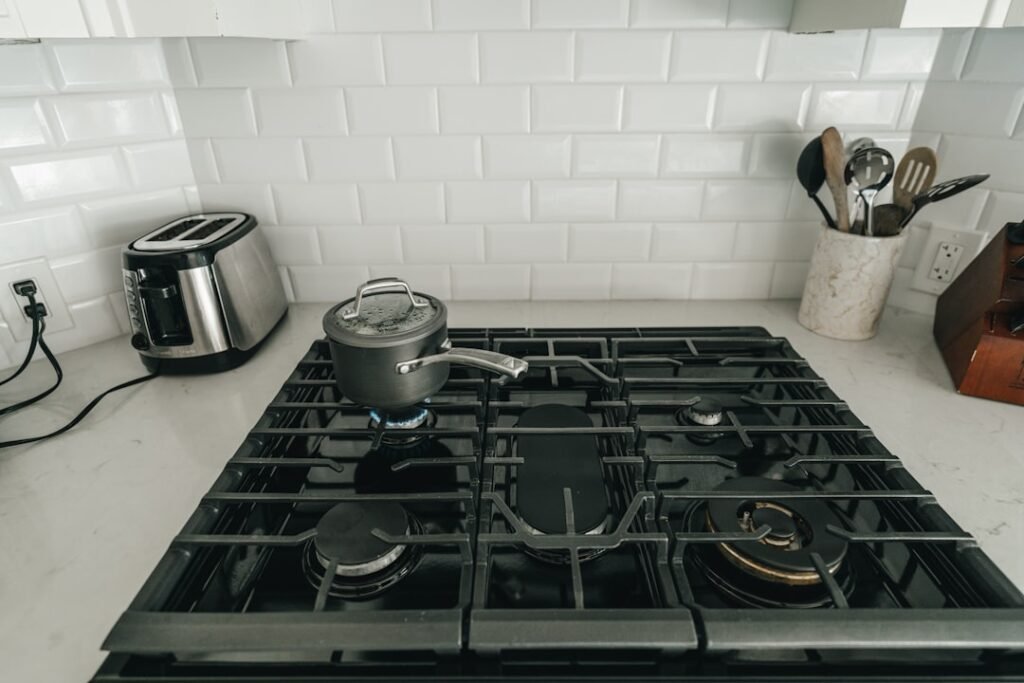
Featured photo by Henry Kobutra on Unsplash.
Pingback: What Cookware Works on Portable Induction?
Pingback: Induction Cooktop vs Electric Hot Plate
Pingback: Why Is My Induction Cooktop Noisy? Safe Checks
Pingback: Portable Induction Cooktop Keeps Shutting Off? Safe Checks